
'/%3e%3c/svg%3e) Create Project
Create Project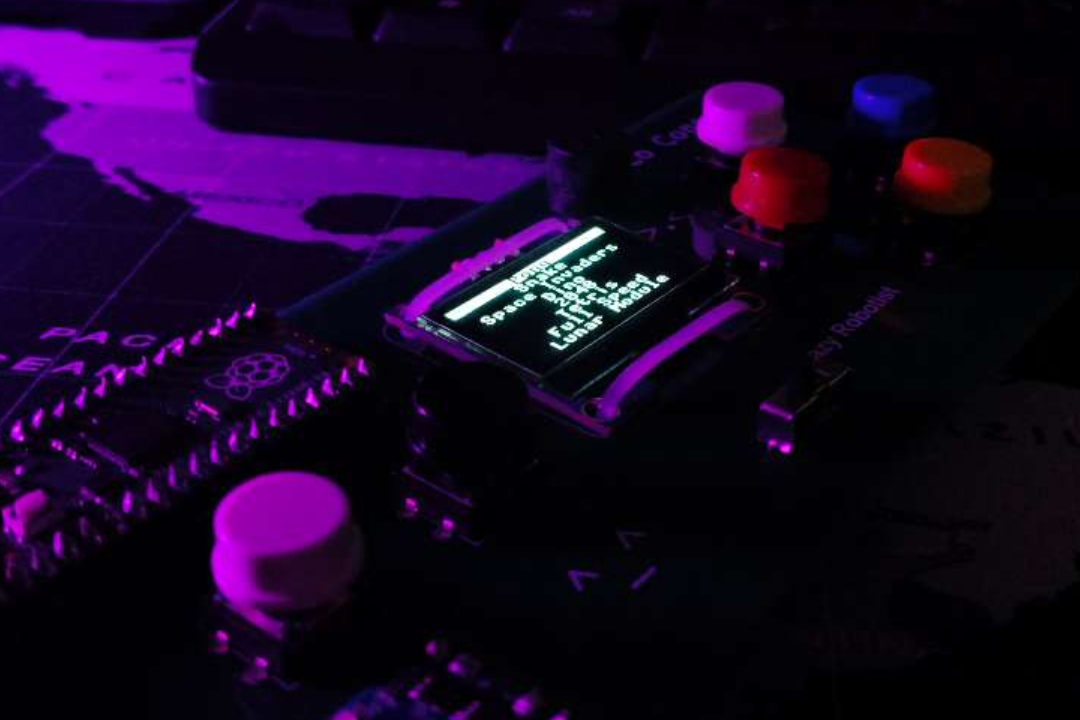


;}.c{fill:%23dbdbdb;}.d{fill:none;stroke:%23333;stroke-linecap:round;stroke-linejoin:round;}%3c/style%3e%3cclipPath%20id='a'%3e%3crect%20class='a'%20width='22'%20height='22'/%3e%3c/clipPath%3e%3c/defs%3e%3cg%20class='b'%3e%3cg%20transform='translate(1.375%202.251)'%3e%3cpath%20class='c'%20d='M7.563,9.224A20.661,20.661,0,0,1,18.8,8.265l-7.088,7.329-.922-.373-.023-3.312-1.389-.741-2.555.389-3.56,2.989-2,1.7s-.1-4.771,6.3-7.021'%20transform='translate(-0.5%200.249)'/%3e%3cpath%20class='d'%20d='M12.174.745l7.332,7.332a.834.834,0,0,1-.017,1.195L12.157,16.2a.833.833,0,0,1-1.405-.606V12.679a.844.844,0,0,0-.931-.832A11.108,11.108,0,0,0,2,16.74a.834.834,0,0,1-1.5-.576C1.132,9.59,3.786,5.4,9.942,5.066a.841.841,0,0,0,.81-.829v-2.9A.833.833,0,0,1,12.174.745Z'%20transform='translate(-0.5%20-0.5)'/%3e%3c/g%3e%3c/g%3e%3c/svg%3e)
Pico Console v1 is a compact, fully PCB-based retro gaming console built around the Raspberry Pi Pico. The goal of this project was to design a minimal yet functional handheld-style gaming device that integrates all essential components directly onto a single PCB, without relying on any external enclosure or mechanical housing.
Unlike many DIY handheld consoles that use perfboards, wires, or 3D-printed cases, Pico Console v1 is designed as a clean, integrated hardware platform. Every component—from power management to user input—is carefully placed on the PCB to create a robust and reproducible design suitable for learning, experimentation, and future expansion.
At the heart of the console is the Raspberry Pi Pico, chosen for its simplicity, availability, and strong MicroPython ecosystem. The console uses a SSD1306 OLED display, providing a crisp monochrome output that works well for classic retro-style games while keeping power consumption low. The display is driven over I²C, making it simple to interface and reliable for small embedded projects.
User input is handled through multiple 12×12 mm tactile push buttons, arranged to replicate a classic handheld console layout. These buttons provide a solid tactile feel and are directly connected to the Pico’s GPIO pins, eliminating the need for external input boards or wiring. A small buzzer is also included on the PCB to enable simple sound effects and feedback during gameplay.
Power management is handled using a TP4056 lithium battery charging module, allowing the console to be powered by a 600 mAh Li-ion battery. The TP4056 enables safe and convenient USB charging, making the device portable and easy to recharge. A dedicated on/off slide switch is included to completely disconnect the battery when the console is not in use, improving safety and battery life.
One of the defining features of Pico Console v1 is that it is designed to function without any outer shell or enclosure. The PCB itself acts as the structure of the device, giving it an exposed, electronic aesthetic while also making assembly straightforward. This approach keeps the project simple, cost-effective, and ideal for anyone interested in PCB-based product design or compact embedded systems.
This project focuses primarily on hardware design. The PCB schematic and layout were created from scratch and are original. Firmware is not included in this project. During testing, the console was operated using publicly available example code and open-source libraries for the Raspberry Pi Pico and SSD1306 display. Users are free to develop or adapt their own firmware depending on their requirements.
The design files shared here can be used as a reference or starting point for similar projects, modifications, or future revisions. Possible upgrades include adding a larger display, improving audio output, redesigning the button layout, or integrating a custom enclosure. This project is shared with the community to encourage experimentation, learning, and hands-on exploration of embedded hardware design using the Raspberry Pi Pico.
;}.c{fill:%23555;}%3c/style%3e%3cclipPath%20id='a'%3e%3crect%20class='a'%20width='18'%20height='18'%20transform='translate(1543%202144)'/%3e%3c/clipPath%3e%3c/defs%3e%3cg%20class='b'%20transform='translate(-1543%20-2144)'%3e%3cpath%20class='c'%20d='M182.144,108.918a.7.7,0,1,1-1.407,0V98.083l-.033.027-.054.05-5.045,5.045a.7.7,0,0,1-1.041-.945l.046-.05,5.045-5.045a2.508,2.508,0,0,1,3.477-.031l.075.072,4.988,5.022a.7.7,0,0,1-.949,1.038l-.05-.046L182.21,98.2l-.066-.061Zm5.394-15.827a.7.7,0,1,1,0,1.407h-12.2a.7.7,0,1,1,0-1.407Z'%20transform='translate(1370.601%202051.909)'/%3e%3c/g%3e%3c/svg%3e "Back to top")